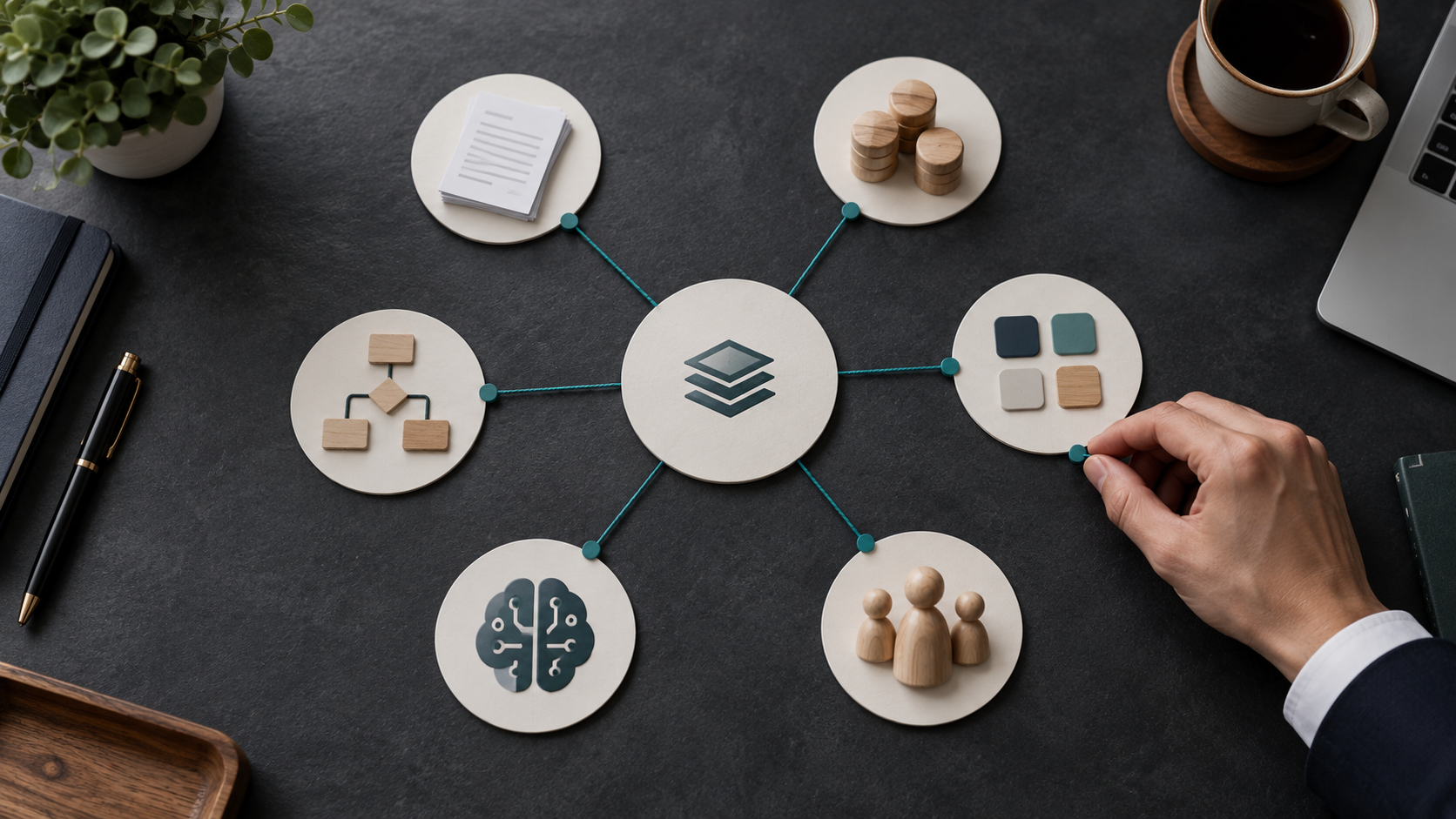
Enterprise AI is no longer one tool used for one task. Organizations are accumulating models, agents, applications, documents, data sources, workflows, and AI-generated outputs across many teams. Each element may be useful on its own. The difficulty is getting those elements to work together inside the organization’s context, rules, and operating processes.
AI Orchestration as a Service describes the layer that coordinates that environment. It connects approved organizational context with the systems, people, controls, and workflows required to turn AI activity into repeatable work.
A working definition
AI Orchestration as a Service is a secure, managed layer that connects an organization’s data, knowledge, applications, models, agents, people, and workflows so AI-supported work can operate with shared context, defined permissions, governance, and human accountability.
The definition matters because enterprise AI has become fragmented. One team may rely on a general-purpose model. Another may build an internal assistant. A third may test agents. Important context remains divided among databases, files, applications, email, and people. Without a coordination layer, each initiative has to rebuild context, controls, and process around itself.
What the orchestration layer coordinates
An orchestration layer does not need to replace every tool the organization already uses. Its role is to help those tools participate in a governed operating environment. Depending on the workflow, that environment may coordinate several elements.
- Organizational context that helps AI interpret the work correctly
- Approved data and knowledge that people and AI systems are permitted to use
- Models and agents selected for different tasks
- Applications and systems that supply information or receive an approved output
- Permissions and boundaries that determine who can use what
- Human review for work that requires judgment or accountability
- Workflows that carry a result from one stage to the next
The value comes from coordinating these elements as a system. A strong model cannot solve a permission problem. An agent cannot create trustworthy organizational context by itself. A workflow cannot be governed if no one can see how information and decisions moved through it. Orchestration addresses the relationships among the parts.
Why the service component matters
Enterprise environments change. Teams adopt new tools, data sources evolve, permissions shift, and processes are revised. Orchestration is therefore not a one-time connection project. It requires ongoing configuration, workflow support, monitoring, and adaptation.
The phrase as a Service signals that the orchestration layer must continue operating as the organization changes. The exact commercial and technical model may vary, but the underlying need remains the same: coordination has to be maintained, not merely installed.
What AI orchestration is not
AI orchestration is related to automation, integration, AI platforms, and agent systems, but it is not interchangeable with any one of them. Automation performs a task or sequence. Integration connects systems. An agent can plan or act toward a goal. Orchestration coordinates the larger environment around those capabilities, including context, permissions, human participation, and the movement of work across systems.
It is also not a promise that every decision should be automated. In many enterprise workflows, the right outcome is better coordination between AI capabilities and responsible people.
Why this category is emerging now
The first phase of enterprise AI focused on access. Organizations wanted to know which models they could use and where AI might save time. The next phase is operational. Leaders now have to decide how many AI capabilities will work together, how knowledge will carry forward, and how the organization will retain control.
That is the need AI Orchestration as a Service is intended to address. BloomifAI is building around this category because the enterprise does not need another disconnected AI experience. It needs a practical way to coordinate AI with the information, people, and processes that make the work useful.
A practical next question
Instead of asking only which AI tool to deploy next, organizations can ask a broader question: what must connect around this workflow for AI to produce a result we can trust, review, and use again?
How orchestration changes enterprise AI planning
A tool-by-tool AI strategy encourages every team to solve its immediate problem independently. That can create fast local progress, but it also multiplies decisions about data access, model selection, review, retention, and integration. The organization eventually has to manage a growing collection of separate operating patterns.
An orchestration strategy starts with the work that must happen across those tools. Leaders identify which context needs to travel, which controls should remain consistent, and where different AI capabilities can be substituted without rebuilding the entire process. The conversation moves from choosing a single winning model to designing a dependable environment in which several capabilities can participate.
This shift can also improve investment decisions. A new model, agent, or application is easier to evaluate when the organization knows how it would connect to existing context, permissions, workflows, and review. The question is no longer only whether the technology performs well in isolation. It is whether the capability can contribute to a governed process the organization is prepared to operate.
How to evaluate an orchestration approach
A credible orchestration approach should be explainable in operational terms. Buyers should be able to see how information enters a workflow, how access is determined, where AI supports the work, when people participate, and what happens to the approved result. A diagram alone is not enough if the provider cannot connect it to a demonstrable process.
- Begin with a workflow the provider can demonstrate from approved input to final output
- Ask how organizational context is assembled and kept relevant
- Confirm how permissions apply to people, data, models, agents, and actions
- Identify the points where human review is required or configurable
- Understand how the workflow is monitored, updated, and supported over time
- Separate current capability from planned architecture and long-term vision
The category will continue to develop as enterprise AI changes. A useful definition should therefore be specific enough to guide decisions without pretending that every technical and commercial model has already been settled. The central idea is durable: organizations need a layer that coordinates AI with the context, controls, people, and workflows of the enterprise.