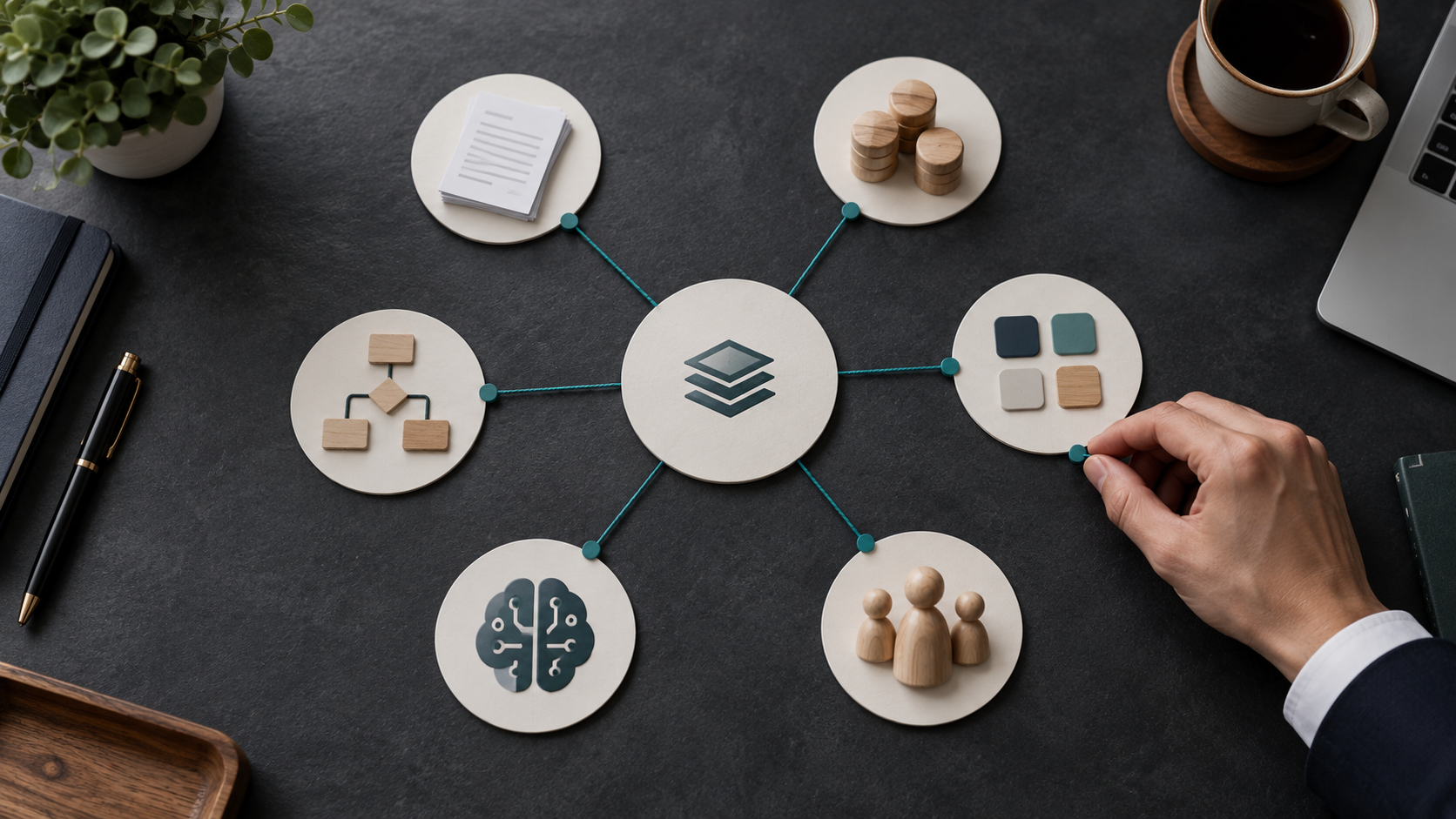
An AI-orchestrated enterprise is not an organization in which every decision is automated or every team uses the same model. It is an organization that can coordinate many forms of AI through shared context, controls, workflows, and human accountability.
The difference is visible in how work moves. AI activity no longer begins and ends inside isolated tools. Useful information can enter a governed process, involve the right people, and carry forward into the next decision.
The enterprise foundation remains in place
Organizations already have systems that manage customers, operations, finance, documents, identity, and communication. They also have institutional knowledge that lives in policies, prior work, subject-matter expertise, and team practices.
An orchestrated enterprise does not discard that foundation. It makes approved portions of the foundation available to AI-supported work. The goal is to connect existing context and systems, not require every process to move into one new application.
A shared orchestration layer coordinates the work
The orchestration layer sits between the enterprise foundation and the people and AI capabilities doing the work. It helps coordinate context, permissions, governance, workflow, and review across the selected systems.
This layer gives the organization a consistent way to answer practical questions. Which information may this workflow use? Which model or agent is appropriate? Who must review the result? Where should the approved output go? What knowledge should remain available for future work?
People and AI work inside defined roles
People remain part of the operating model. They set objectives, provide judgment, resolve ambiguity, approve sensitive actions, and remain accountable for consequential decisions. AI capabilities can support research, analysis, drafting, coordination, and other defined tasks.
The exact division of work will differ by process. What matters is that the division is intentional. Human participation is designed into the workflow rather than added as a general reminder to check the result.
Context travels with the workflow
In a fragmented environment, every person or tool has to rebuild context. Teams copy information between systems, explain the same background repeatedly, and search for the latest approved version of a document or decision.
In an orchestrated environment, the workflow can carry the approved context required for each stage. That reduces repeated setup and helps models, agents, and people work from a more consistent understanding of the task.
Useful knowledge carries forward
Many useful AI outputs disappear into individual chat histories. An orchestrated enterprise can review, organize, and retain the parts that deserve to become shared organizational knowledge.
This does not mean every generated answer should be preserved. The organization decides what has been validated, who may reuse it, and when it should be revised or retired. The result is a more deliberate path from temporary output to reusable capability.
Governance surrounds the system
Governance is not a separate step applied after innovation. Access, data boundaries, monitoring, review, and accountability shape how the workflow operates from the beginning.
This becomes increasingly important as AI moves closer to real business processes. The more context and action the system can access, the more clearly the organization must define its operating boundaries.
Business outcomes stay connected to the process
An orchestrated enterprise should be able to connect AI-supported activity to work the organization recognizes: a completed report, a resolved request, a reviewed proposal, a retained body of knowledge, or a better-informed decision.
This changes the measurement question. Instead of tracking only tool adoption or prompt volume, the organization can examine whether a workflow became more consistent, reviewable, reusable, or effective.
A practical way to begin
The AI-orchestrated enterprise is an operating direction, not a requirement to transform every process at once. A useful first step is to select one recurring workflow that already crosses information sources, systems, and people. Map the context, controls, handoffs, and output. Then decide where AI can support the work and what must remain under human control.
One well-defined workflow can make the operating model concrete.
What changes for enterprise leaders
An orchestrated operating model changes the responsibilities of several leadership groups. Technology leaders still evaluate architecture, performance, and integration, but they also help define reusable patterns for context, permissions, and monitoring. Business leaders become responsible for naming the outcomes, owners, and review points that make a workflow useful. Security and legal teams participate in the operating design instead of reviewing a finished implementation in isolation.
This shared responsibility can reduce a common source of delay. AI programs often move quickly during experimentation and then slow when they reach questions about ownership, data, or accountability. Addressing those questions in the workflow design makes them part of execution rather than a final gate.
What maturity can look like
Organizations will mature at different speeds, but the progression is often recognizable. Early AI use is personal and disconnected. Teams then begin sharing prompts, tools, and limited automations. A more mature stage introduces approved workflows, reusable context, role-based access, and defined human review. Over time, the organization can coordinate several AI capabilities through common operating patterns.
Maturity does not mean eliminating exceptions or centralizing every decision. It means the organization can explain how AI-supported work is supposed to operate, see where it does not, and improve the process without starting over.
- Workflows have named owners and measurable outcomes
- Context and knowledge can be reused within approved boundaries
- People understand where they review, approve, or intervene
- Models and agents can change without redefining the entire business process
- Governance and monitoring are connected to the workflow
- Approved outputs can become inputs to future work